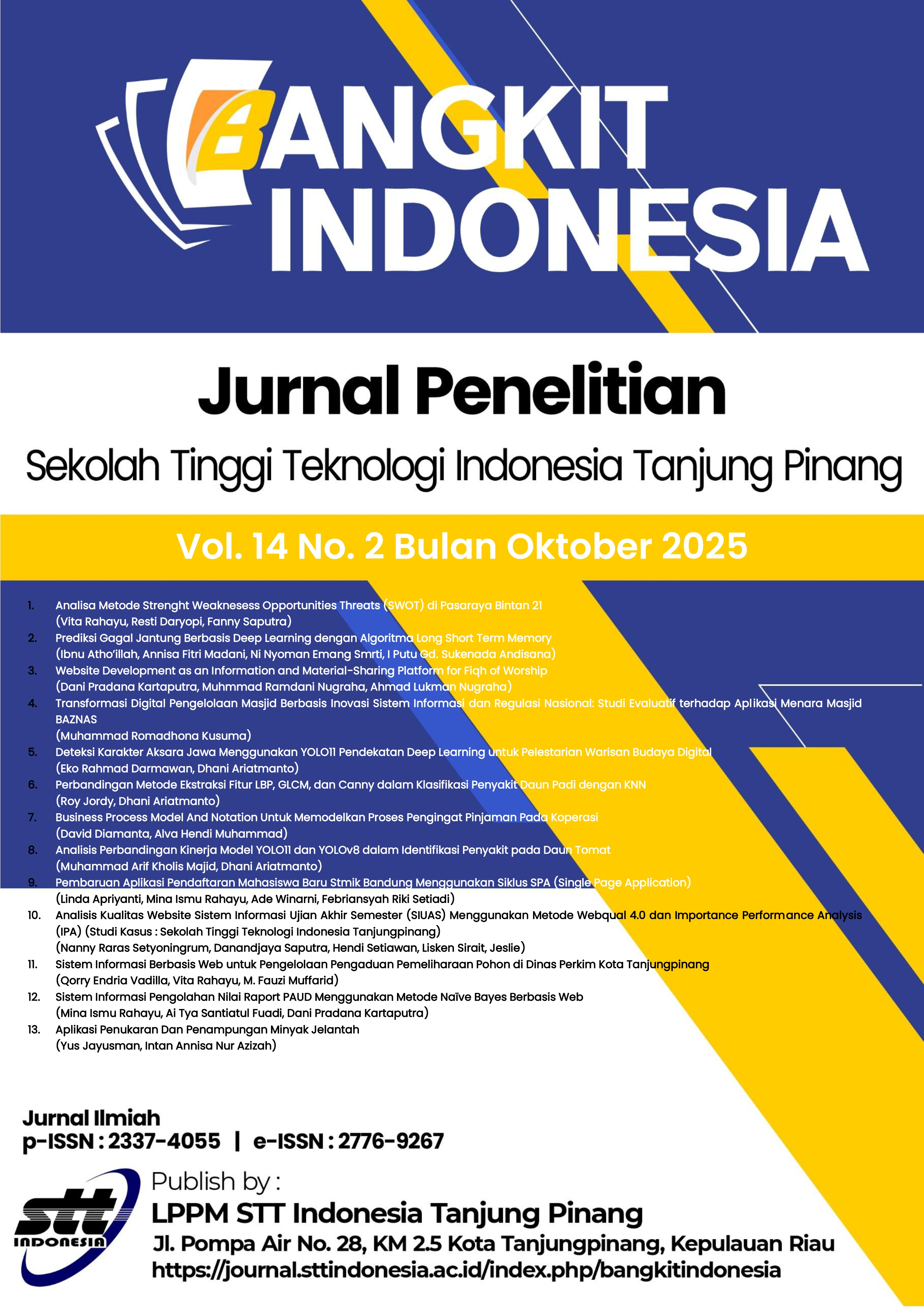
Prediksi Gagal Jantung Berbasis Deep Learning dengan Algoritma Long Short Term Memory
Keywords:
Accuracy, Confusion Matrix, Heart Failure, Long Short-Term Memory, TensorFlowAbstract
Heart failure is one of the leading causes of death in the world. Early detection and accurate analysis are essential for proper treatment. This study proposes the use of Long Short-Term Memory (LSTM) algorithm to analyse and predict the progression of heart failure disease based on patient medical data. The LSTM model developed uses the Python platform with TensorFlow and Keras libraries, as well as the “Heart Failure Prediction” dataset from Kaggle.com. The results showed that the LSTM model with training and testing data ratio of 70:30 (Model B) achieved the best performance with accuracy of 0.869, precision of 0.869, recall of 0.869, and F1-score of 0.869. The model showed consistent ability in identifying positive and negative cases of heart failure and was effective in reducing overfitting. Overall, this research contributes to the development of more accurate and efficient heart failure disease prediction methods.